Posts

Showing posts with the label electronic tempering valve

Oklahoma Sooners Play Ball With Heat Timer

Image
At Oklahoma University, the drive for excellence has a long and proud tradition both in the classroom and on the football field. Lesser known however, is the university’s constant drive toward excellence and efficiency in its building operations. That’s why during a recent retrofit of its domestic hotwater equipment , UA selected the Heat-Timer® ETS (Electronic Tempering Station) as its choice for master mixing and control. With over 30,000 students on campus, Oklahoma University has multiple on-campus dorms including the twin 12 story buildings of the Couch and Walker Centers.  These buildings are a focal point of student housing located in the center of the campus. As is common in high rise dormitories, the domestic hot water system includes steam to water exchangers and a master mixing valve. UA Facilities Team Confronts A Hot Problem Over the years the domestic hot water system in these (and other) buildings at OU, have required costly maintenance and repairs while still ...
What “Penny Wise & Pound Foolish” says about Domestic Hot Water Solutions

Image
The actual phrase “penny wise, and pound foolish” is often mistakenly credited to Benjamin Franklin, but it actually originated with an Oxford Scholar named Robert Burton in his book, “The Anatomy of Melancholy” written in 1621! Needless to say, in 1621 domestic hot water wasn’t even a thing. It was before the advent of electricity, multi-story distributed hot water systems, and certainly before the advent of modern boilers, computerized boiler controls and mixing valves. And yet the phrase is nowhere more relevant than when it is applied to DHW installations where mixing valves are sometimes omitted for small overall reductions in material cost or piping complexity in a commercial, domestic hot water setting. So here’s “penny wise and pound foolish” as applied to  your domestic hot water system . The Purpose of a 3 Way Mixing Valve in DHW In DHW applications using traditional direct-fired storage tank systems, a mixing valve has always been an important part of the overa...

Four Ways to Save Money with a Smarter Apartment Building

Image
As most apartment building managers will tell you, energy costs are one of the most significant operating expenses in commercial buildings. Inside those energy costs, heating and Domestic Hot Water are two of the most significant expenses, especially in older buildings constructed before energy efficiency standards were established. In the past, the primary way to reduce heating costs was through major investments in new boilers, piping, valves, radiators, windows and building insulation. While these investments can certainly be warranted, especially if your system is more than 15 years old, that didn’t always fix the problem with apartment 2E being so cold, and 4H being overheated. Smart building controls with internet accessibility and wireless space sensors have given building managers another option. With smart building controls like the Heat-Timer® Platinum series for boiler management , or the Heat-Timer® ETV for control of Domestic Hot Water. You can significantl...

Understanding Commercial Tempering Valve Systems

Image
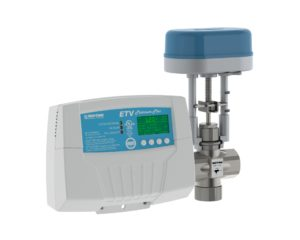
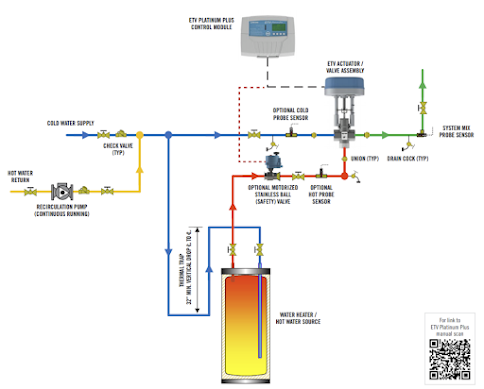
 As most HVAC professionals already know, tempering valves (sometimes referred to as hot water mixing valves or thermostatic mixing valves) are used to blend hot and cold water together in a domestic hot water delivery system. The resultant water at a reduced temperature is sent through the delivery system at exactly the right temperature for use at the sink, the shower etc. Mixing valves like this solve a particular problem in the delivery of hot water in large buildings, during periods of peak demand. Hot water in the storage tank must be kept above 140 degrees Fahrenheit to prevent the growth of harmful bacteria. Yet water at this temperature would instantly scald and burn anyone putting their hand under it.  By mixing the hot with cold water, and monitoring the “set point” temperature carefully, these valves ensure that water at the desired set point is delivered to users at all times and under all load conditions. See our discussion for a detailed explanation ...