Posts

Showing posts with the label Domestic Hot Water Controls

What “Penny Wise & Pound Foolish” says about Domestic Hot Water Solutions
Image
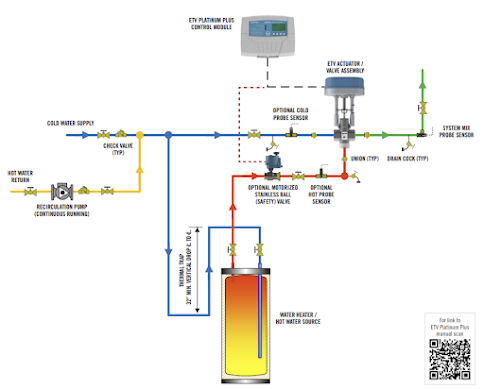
The actual phrase “penny wise, and pound foolish” is often mistakenly credited to Benjamin Franklin, but it actually originated with an Oxford Scholar named Robert Burton in his book, “The Anatomy of Melancholy” written in 1621! Needless to say, in 1621 domestic hot water wasn’t even a thing. It was before the advent of electricity, multi-story distributed hot water systems, and certainly before the advent of modern boilers, computerized boiler controls and mixing valves. And yet the phrase is nowhere more relevant than when it is applied to DHW installations where mixing valves are sometimes omitted for small overall reductions in material cost or piping complexity in a commercial, domestic hot water setting. So here’s “penny wise and pound foolish” as applied to  your domestic hot water system . The Purpose of a 3 Way Mixing Valve in DHW In DHW applications using traditional direct-fired storage tank systems, a mixing valve has always been an important part of the overa...

Commercial Domestic Hot Water Trends 2020

Image
  Technology marches on and for those of us working every day to bring the best DHW solutions to the market, global and national trends will inevitably drive the adoption of new techniques and new technologies that mostly help, but sometimes hurt us. Digital and IOT based improvements to the tech surrounding DHW abound in 2020 and conversations around the “resident experience” are now common, though studies show that a desire for positive resident experiences have not become a core technology competency for the vast majority of building managers.  For DHW used in hotels, apartments, and office buildings, upgrades, and conversions continue to be a major source of industry growth despite this, as operators recognize the need for more efficient systems, and the impact of upgrades on bottom-line operating costs. Focus on the Commercial Domestic Hot Water Market The U.S. commercial water heater  market revenue  is poised to cross USD 670 Million by 2026, as reported i...

Water Safety For all Time

Image
Because of regulations put in place after the outbreak of legionnaire’s disease in the 90’s, installation of Domestic Hot Water (DHW) systems were changed for the sake of public safety.  All DHW systems, whether storage based or tankless, must now meet the conflicting requirements of holding DHW at a minimum of 140°F (60°C) to comply with such standards as OSHA Technical Manual Section 3 Chapter 7, to combat Legionella growth, while delivering hot water at a temperature that prevents scalding injuries in sinks and other fixtures. For decades, commercial plumbing installers have embraced a 3 way mixing valve or “tempering valve” as the perfect solution to the dilemma. Early tempering valves were controlled manually with fixed setpoints, but in 2020 we have evolved to using motorized valves under the direction of a standalone electronic control station that adds flexibility, reduces energy use, provides alerts and alarms, and generally improves the safety of any domestic ...

A Primer on Commercial Domestic Hot Water Solutions

Image
What is a Domestic Hot Water System? A Domestic Hot Water (DHW) system provides potable hot water to our sinks, showers, and tubs and other places where hot water may be ingested by, or come in direct contact with humans. This is as opposed to non-potable water which is not suitable for drinking and other domestic purposes but may be used for hydronic heating, industrial cleaning and other applications. Most plumbing codes specify that all piping, components, and heat-transfer devices in contact with the potable water shall be intended for use in potable water systems. Typical commercial DHW systems consist of one or more boilers that provide a reserve of hot water for use. Since demand for hot water is not uniform across the day, DHW control systems are sized to try to balance the costs of heating large tanks of hot water, while still being able to meet the anticipated demand during a peak period (usually when people are getting ready for work in the morning) Key Parts o...